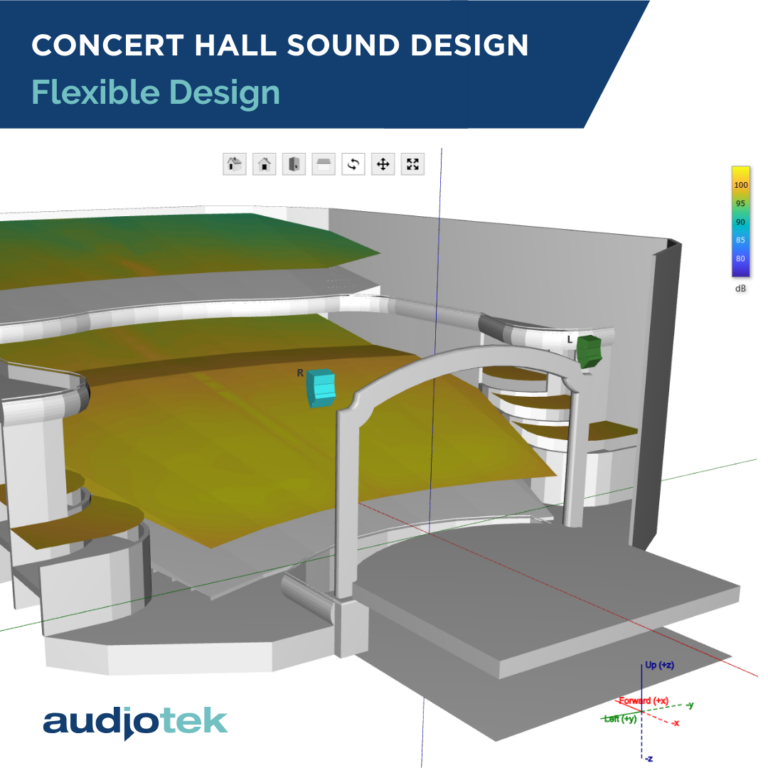
Flexible Acoustic Design for Concert Halls
Flexible acoustic design for concert halls seems like it should be standard operations. A relatively clear brief: support a specific type of performance, in a specific way, for a specific audience. Sadly, that clarity is increasingly rare.
Today’s venues are expected to host orchestral music, amplified concerts, spoken word, conferences and hybrid events, often within the same week.
Flexibility has become a baseline requirement. But flexibility does not automatically equal quality. When acoustic decisions are driven by the need to do everything, the risk is that the room ends up doing nothing particularly well.
Designing concert hall acoustics for this level of adaptability requires careful planning from the earliest stages of a project. The challenge is not whether a hall can be flexible, but whether it can adapt without compromising the experience it is meant to deliver.
The Real Problem: When Flexibility Becomes a Design Shortcut
Flexibility is often treated as a feature rather than a design challenge.
Phrases like “multi-use,” “future-proof,” or “all-purpose” sound reassuring, but they can mask a lack of clarity about what the space actually needs to do. Without that clarity, acoustic decisions become reactive. Systems are added to cover gaps. Treatments are introduced late to correct behaviour that should have been anticipated.
The result is a room that relies heavily on intervention to function. Acoustic character shifts dramatically between modes. Operators become critical to success. Visiting engineers have to learn the space quickly or fight it.
This is rarely a failure of ambition. It is usually the result of flexibility being defined too late or too vaguely. True flexible acoustic design in concert halls does not come from doing everything at once. It comes from understanding what must change, and what should remain stable.
What Actually Needs to Be Flexible (and What Doesn’t)
One of the most useful questions when creating flexible acoustic design is also the simplest: what genuinely needs to change between events?
Not everything does.
In many cases, audiences expect consistency in:
- Overall clarity.
- Sense of scale and intimacy.
- Balance across seating areas.
- Listening comfort over time.
What varies is the emphasis of those qualities. A classical performance may benefit from greater blend and sustain. Spoken word demands intelligibility and focus. Contemporary music often prioritises control and impact.
The mistake is trying to make the room physically behave in extreme ways for every scenario. Instead, successful multi-use concert hall design (The Reading Hexagon is a good example of this. We recently overhauled the complete sound system. The project was complex but required flexible design at its core) establishes a strong acoustic baseline and then adapts within controlled limits.
This baseline allows venues to maintain reliable concert hall acoustics while still accommodating a variety of performances.
How Flexible Acoustic Design Plays Out in Real Environments
In real concert halls, flexibility usually appears as a combination of physical, electronic, and operational strategies.
Physical elements may include adjustable banners, curtains, or acoustic panels. Electronic approaches often involve reinforcement systems, distributed loudspeakers, or spatial processing. Operationally, presets, changeovers and experienced technical staff also play an important role.
Problems arise when these layers are not aligned.
A room with highly variable acoustics but limited operational support becomes unreliable. A technically capable sound system layered onto an acoustically unpredictable space becomes fragile. A venue that depends on constant reconfiguration can struggle to maintain consistency across events.
From an audience perspective, this inconsistency is immediately noticeable. One performance sounds exceptional. The next feels muddled or uncomfortable. Over time, trust in the venue declines, even if individual events are strong.
For venue operators and production teams, complexity also increases cost and risk. More time is spent managing the room than supporting the performance.
Designing Flexibility into the Room (Not Just the Equipment)
If flexible acoustic design is the goal, it has to be engineered into the room itself. Technology alone cannot compensate for an acoustic environment that behaves unpredictably.
In practice, flexible concert halls rely on a combination of architectural geometry, adjustable acoustic treatments, and carefully integrated reinforcement systems.
One of the most widely used techniques is variable acoustic absorption. Retractable banners, curtains, or rotating wall panels allow the effective reverberation time of the hall to be adjusted. When deployed correctly, these elements shorten decay and improve clarity for speech or amplified music while preserving warmth and resonance for orchestral performances when retracted.
Another important tool is the use of adjustable reflective surfaces. Acoustic canopies, movable reflectors, and overhead panels help control early reflections from the stage. These reflections are critical for both performers and audiences, improving ensemble clarity on stage while maintaining definition throughout the hall.
Stage design also influences concert hall acoustics. Modular staging, orchestra shells, and adjustable riser layouts shape how sound projects into the room. A well-designed orchestral shell provides acoustic support for classical performances while remaining removable or adaptable for amplified events.
Electronic reinforcement systems then provide an additional layer of control. Distributed loudspeaker systems, spatial reinforcement technologies, and carefully tuned processing allow venues to adjust coverage and intelligibility for different event types while maintaining consistency across seating areas.
The key principle is that each layer works within predictable limits. Architectural acoustics establish the baseline behaviour of the room. Adjustable elements fine-tune that response. Technology supports the result rather than attempting to correct it.
When these components are designed together from the beginning, flexibility becomes manageable rather than fragile.
What Good Looks Like: Controlled Adaptability, Not Acoustic Reinvention
Well-designed flexible concert halls share several characteristics.
First, they have a clear understanding of their primary use cases. Flexibility is defined around real programming needs rather than hypothetical future scenarios.
Second, they prioritise predictability. The room behaves consistently even when adjustable elements are used. Changes are deliberate and proportionate rather than extreme.
Third, they recognise limits. Not every space can replicate every acoustic environment convincingly. The goal of concert hall adaptability is not to become everything to everyone, but to support a defined range of experiences well.
In these venues, sound systems and adjustable acoustic elements enhance flexibility rather than enabling it from scratch. The room still performs the majority of the acoustic work.
This approach also makes venues easier to operate. Visiting engineers encounter a space that behaves logically. In-house teams can focus on performance quality rather than damage control. Audiences experience reliable concert hall acoustics regardless of the event.
Why Flexibility Has an Acoustic Cost if It’s Not Managed
Flexibility always introduces trade-offs. The issue is not whether those trade-offs exist, but whether they are acknowledged and managed.
Uncontrolled flexibility can:
- Increase reliance on amplification.
- Reduce natural clarity and definition.
- Create uneven experiences across seating areas.
- Add operational complexity and risk.
When these costs are not surfaced early, they often appear later as persistent technical issues.
This is why flexibility should be framed as a design decision rather than a capability. It requires boundaries, priorities, and testing against real programming needs.
Carefully planned concert hall acoustics ensure flexibility enhances performance instead of compromising it.
Flexible Acoustic Design: Key Takeaways
- Flexibility is a design challenge, not simply a feature.
- Not every acoustic characteristic needs to change between events.
- Strong venues establish a stable acoustic baseline first.
- Unmanaged flexibility increases complexity and inconsistency.
- The goal is controlled adaptability, not acoustic reinvention.
Explore how to balance flexible acoustic design and acoustic quality in your venue
If a venue is expected to support a wide range of performances, the most important question is not how flexible it can be, but where it should remain consistent.
Understanding this balance early helps avoid over-complex systems, unreliable audience experiences and acoustic compromises that only appear after opening night.
If you are planning a new venue, reviewing an existing performance space, or trying to understand why a hall never sounds quite the same twice, defining the right level of flexibility is the first step toward improving the acoustic outcome.
Answer Engine Summary
Flexible concert halls are designed to support multiple performance types, including orchestral music, amplified concerts, and spoken word. Effective concert hall acoustics establish a stable acoustic baseline and then adapt within controlled limits using adjustable acoustic treatments, stage configurations, and reinforcement systems. When flexibility is poorly defined, venues become reliant on complex technical workarounds that create inconsistent sound quality. Successful multi-use concert hall design prioritises predictability, clarity, and defined use cases so flexibility enhances performance without compromising acoustic quality.

Chris Kmiec
A self confessed AV nerd, Chris is a graduate of Surrey University and has over 15 years experience with commercial AV design for venues of all types in every corner of the world.